Do leaf hairs contribute to rice productivity? : Strategies to improve water use efficiency by imparting leaf hairiness

Do leaf hairs contribute to rice productivity? : Strategies to improve water use efficiency by imparting leaf hairiness

Tricomes (hair-like protuberances) are often found in plant organs such as leaves, stems, and fruiting bodies, and have been studied mainly in model plants. However, few studies have been conducted on major crop species such as rice, and in particular, the relationship between the trichomes and physiological and ecological characteristics related to crop production has been largely unknown.

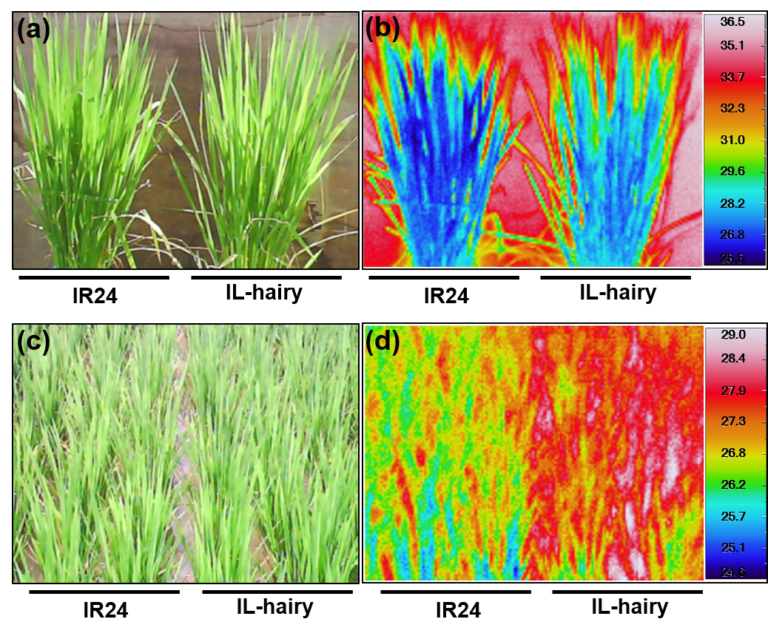
We have focused on the leaf-hairy nature of wild rice O. nivara by selecting leaf-hairy lines from the hybrid progeny of cultivated rice and mapping a single dominant gene for leaf hairiness, BLANKET LEAF (BKL), on chromosome 6.Leaf hair density in the leaf hair line was about 8 times higher than in the cultivated rice parental line, suggesting that BKL elongated the epidermal cells (macro hairs) on the leaf blade microvascular bundles.We also found that this line has 1-2°C higher diurnal leaf surface temperature in individuals and colonies, and that the high density of leaf hairs suppresses transpiration of rice plants and improves photosynthetic water use efficiency. In the future, this trait is expected to be applied to water-saving cultivation in tropical Asia as a useful trait for improving water use efficiency in rice.

We are currently identifying and isolating BKL and other leaf hair genes, while studying the relationship between leaf hair-mediated changes in boundary layer resistance and water use efficiency, and leaf hairy environmental responses (temperature, humidity, drying, etc.).

Figure 1. IR24 and IRGC105715 (a, b), IR24 and IL-hairy (c, d) leaf hair phenotypes. (e) Graphic genotypes of IL-hairy used in linkage analysis. Chromosomal regions derived from IRGC105715 and IR24 are shown in red and white, respectively. (f) Vertical bars indicate the position of SSR markers.

Figure 2. Visual and thermographic images of IR24 and IL-hairy at ear emergence under pot (a, b) and field (c, d) growing conditions.

Figure 3. Photosynthetic characteristics of IR24 and IL-hairy. Net photosynthetic rate (Pn), transpiration rate (Tr), diffusion conductivity (gl) and photosynthetic water use efficiency (WUEp) under different light intensities (ML: 400 μmol m-2 s-1; HL: 1500 μmol m-2 s-1) at ear emergence. The values in parentheses are the ratio of IL-hairy values to IR24 values (%).