Elucidation of the mechanism of abnormal water temperature phenomenon in tropical saltwater aquaculture ponds and the actual situation of water quality abnormality and fishery disease as a response to the phenomenon

Elucidation of the mechanism of abnormal water temperature phenomenon in tropical saltwater aquaculture ponds and the actual situation of water quality abnormality and fishery disease as a response to the phenomenon

In recent years, there has been a movement, especially in Southeast Asian countries, to move away from intensive aquaculture with its high environmental impact and return to environmentally friendly coarse-grain aquaculture with the aim of restoring the ecosystem. In the coarse-grain aquaculture method, aquaculture ponds are constructed using the natural topography, and the water is managed by utilizing the surrounding river water and tidal currents to feed organisms contained in the aquatic environment. Although this method has been shown to restore and improve the environment, from an environmental hydrological viewpoint, it is considered to be an aquaculture method that tends to induce abnormalities in the aquatic environment. Specifically, rainfall during the tropical rainy season and heat after rainfall may trigger aquatic environmental abnormalities.

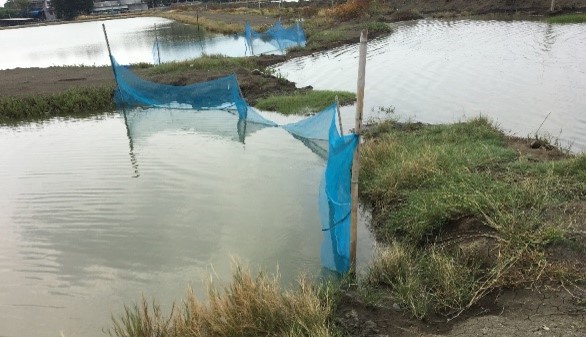
Coarse-grain ponds in Samut Songkhlaeng Province, Thailand

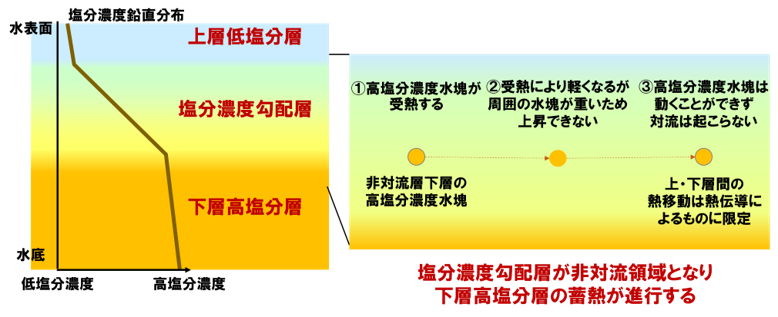
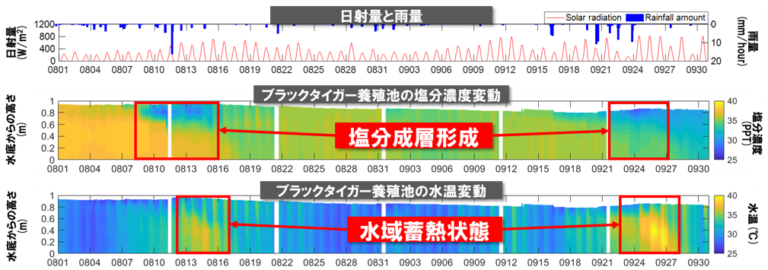
First, since seawater or brackish water is used as production water for aquaculture, rainfall inflow into aquaculture ponds causes the formation of a salt stratification layer composed of fresh water and salt water. When the water temperature rises due to heat during the formation of this salt stratification, the salinity gradient layer at the boundary between fresh and salt water becomes a non-convective area, which interferes with material and thermal circulation, resulting in anomalies in the aquatic environment. The figure below shows an example of water environmental anomalies caused by tropical rainfall observed in a saltwater aquaculture pond in Prachuap Khiri Khan Province, Thailand. Normally, water density decreases with depth because water density is lighter at higher temperatures and heavier at lower temperatures. However, in the observed case, after the formation of a saline stratification due to rainfall, there is a period of time when the water temperature is maintained at nearly 40°C from the bottom to the middle of the water body. 

Non-convective mechanisms in salinity gradient layers 

Field Observations of Black Tiger Farming Ponds

Observation period: August 1 – September 30, 2019
Observation Pond: Experimental aquaculture ponds at the Cuu Long Wan Fisheries Research Institute, Kasetsart University

Non-Convective Region Visualization Experiment of Salinity Gradient Layer

Upper layer: salt concentration = 1.7%, water temperature = 25.0℃, lower layer: salt concentration = 4.7%, water temperature = 42.0℃. 
 The salinity gradient layer at the center of the vertical direction is non-convective. The water in the upper layer sinks, but rises before the non-convective zone. The water masses in the lower layer also rise, but settle in the non-convective zone. 

When such water temperature anomalies occur in saltwater aquaculture ponds, they can degrade water quality and increase the number of pathogenic microorganisms, posing a threat to the productivity and safety of aquaculture products.
In my research, I am working on the elucidation of the mechanism of the phenomena, water quality dynamics as a response to the phenomena, and hydrospheric microbial dynamics by field observations, laboratory hydraulic experiments, water quality analysis, bacterial flora analysis, and numerical simulations, in collaboration with the Faculty of Fisheries, Kasetsart University.

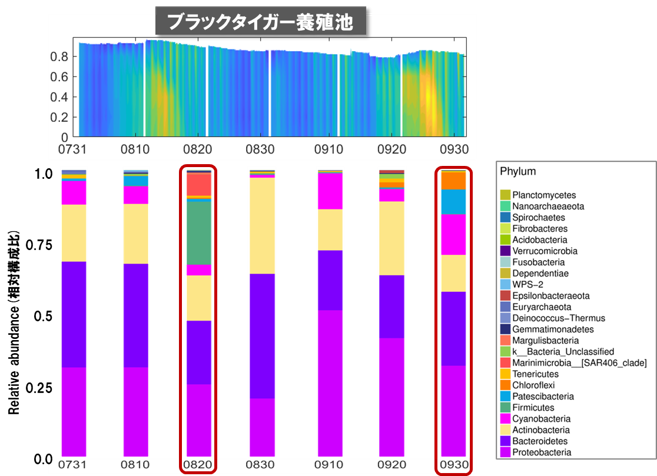
Bacterial flora analysis results

Bacterial flora is changing after the onset of aquatic heat storage.

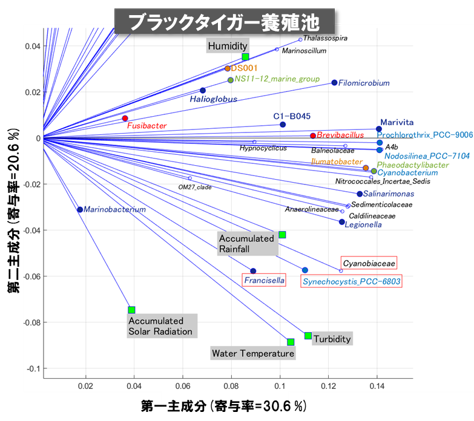
 Principal component analysis of water quality and bacterial genus composition
Genera Francisella, Synechocystis, PCC-6803, and Cyanobiaceae score close to water temperature

Simulation of water temperature diffusion due to rainfall (experimental tank scale)